
Recent Posts
June 20, 2026 Pace Migration Skilled Migration Pathways

Table of Contents
For international students, 2026 has redrawn the map. The Temporary Graduate visa application fee has more than doubled, the age ceiling for most applicants now sits at 35, and since 1 July 2024, graduates have been unable to apply for a Student visa onshore while holding a subclass 485. None of this closes the door to permanent residency. What it does is change who gets through it: the graduates who plan early, sequence their moves deliberately, and treat every month on a temporary visa as an asset. Here is the PR pathway for international students in Australia, step by step.
Permanent residency planning begins before enrolment, not after graduation. Your qualification must meet the Australian study requirement: CRICOS-registered study totalling at least 92 weeks and completed over no less than 16 calendar months. For vocational graduates, it should align with an occupation on the relevant skilled list. A course chosen without checking migration options may leave you with no assessable occupation at the end. Studying in a designated regional area may carry a second advantage: eligible graduates can gain extra visa time, and eligible regional study can add points. Occupation lists shift each program year, so courses linked to persistent demand may offer stronger options, but no course guarantees PR. Speak with student visa agents in Sydney before you enrol, not after.
The Temporary Graduate visa (subclass 485) is the hinge of the entire journey. It lets you live and work in Australia full time after graduating, typically for 18 months to three years depending on your qualification. The conditions have tightened. Most applicants must be 35 or younger, generally apply within six months of completing their course, and meet English requirements that have increased in recent years. The application fee has more than doubled in 2026 and is generally not refunded if your application is refused. Check the current requirements on the Department of Home Affairs website before lodging, and get the stream right the first time.
The most common mistake graduates make is treating the 485 as a breather. It is a countdown. Within your first three months, check the skills assessment pathway for your occupation and sit a fresh English test. Superior English scores add points. A suitable skills assessment is required for points-tested skilled visas, but each assessing authority has different eligibility rules and some take months to process. Graduates who leave these tasks to the final year of their visa often run out of runway. Treat the paperwork as a project with deadlines: assessment pathway confirmed early, English result banked by month six, and an Expression of Interest submitted once your score is competitive.
Four main routes lead from the 485 to permanent residency, and each rewards a different profile.
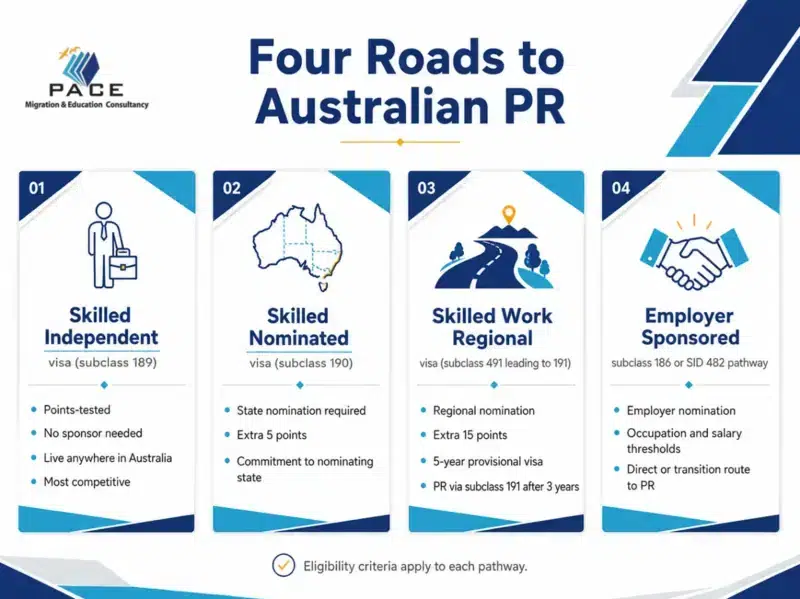
The Skilled Independent visa (subclass 189) is the purest points contest: no sponsor, no strings, and the fiercest competition. The Skilled Nominated visa (subclass 190) trades a state commitment for five extra points and broader occupation lists. The subclass 491 regional visa adds 15 points and can lead to PR through the subclass 191 after three years of meeting regional conditions. And employer sponsorship, through the subclass 186 or the Skills in Demand visa, suits graduates whose employers will back them.
Once your lane is chosen, every decision should add points or evidence. Skilled employment in your nominated or closely related occupation may count; casual work in an unrelated field does not. A NAATI community language credential, a partner’s skills, eligible regional study: each can add points, and invitations in competitive occupations routinely go to candidates well above the 65-point floor. Lodge your Expression of Interest early and keep it current. A skilled migration agent in Sydney can model your score under each pathway before you commit.
Three errors appear again and again. The first is missing the six-month application window after graduation, an error that may end the 485 pathway before it begins. The second is betting everything on a single pathway; when a state closes its nomination program or an occupation drops off a list, graduates with no backup lane lose years. The third is spending the 485 period in work that builds no assessable experience. An unrelated job may pay the rent, but may earn no skilled-employment points or satisfy an assessing authority. All three mistakes share the same cure: a written plan, made early, with a fallback built in.
The rules will keep moving. Your strategy should be built to move with them. Our MARA-registered migration agents in Sydney have guided international students from enrolment to permanent residency since 2007, and we can map your personalised pathway before you spend a dollar on the wrong application. Book a consultation with Pace Migration today.

Syed Rahman
Mr. Rahman is a knowledgeable professional with expertise in academia, corporate management, and migration law. He holds a Post Graduate Certificate in Australian Migration Law from ANU, an MBA in International Business from UTS, and a BBA from Baruch College. With 5 years of corporate management experience, 4 years of teaching experience in Australia, and over 15 years as a registered Migration Agent, Mr. Rahman has a strong background in helping international students and skilled migrants with Australian migration law.
Tags: migration agents in Sydney, Skilled Independent visa (subclass 189), skilled migration agent in Sydney, student visa agents in Sydney, subclass 186
No Comments »
Book an Appointment or Quick Enquiry
© 2007-2026 PACE Migration & Education Consultancy. All Rights Reserved. | Find Us on Top4