
Recent Posts
July 10, 2026 Pace Migration Migration

Table of Contents
Earlier this year, a Sydney restaurant learned the hard way how a sponsorship application unravels. In San Bao Pty Ltd v Minister for Immigration and Citizenship, its nomination of a cook was refused because the Department of Home Affairs was not satisfied the position was genuine. The business missed the tribunal review deadline and took its case, unsuccessfully, to the High Court, where the application was dismissed with costs. The episode captures both halves of the 482 story: many refusal risks are preventable, and much of the damage after a refusal is done in the first few weeks.
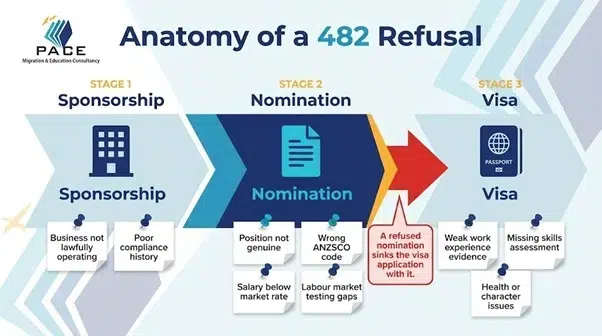
A Skills in Demand visa (subclass 482) matter has three separate stages: the business needs sponsor approval, the position needs nomination approval, and the worker needs visa approval. An already-approved sponsor does not repeat that stage for every worker. What people call a “482 visa refusal” may be a nomination or visa refusal, and a refused nomination generally prevents the visa being granted. Understanding which stage failed is the first step to fixing it.
The genuine position test is a recurring ground of refusal. The Department asks whether the role is real, necessary, and consistent with how the business actually operates. Small businesses may draw closer scrutiny where the nominated role seems out of proportion to turnover or staffing, and hospitality nominations such as chefs, cooks and restaurant managers can require particularly careful evidence. What persuades a delegate is not enthusiasm but structure: an organisational chart that makes sense, contracts and financials that support the role, and a business case explaining why existing staff cannot absorb the duties. Delegates also ask history questions. Was the position previously filled, and by whom? If the role is new, does the evidence show real growth or restructuring behind it? A nomination that cannot answer these questions invites refusal.
Every nomination must identify an applicable occupation, and the duties of the real job must genuinely match its ANZSCO classification. A capable worker can still be refused because a generic or inflated job title was mapped to the wrong code. Job titles are branding; occupation classifications shape the legal assessment. Getting this wrong at the 482 stage can also complicate a later transition to permanent residency through the Employer Nomination Scheme (subclass 186), where the new nomination must independently meet its requirements.
Salary problems cut both ways. Pay that sits below the market rate suggests exploitation; pay inflated beyond commercial logic can suggest the package was built to secure a visa. Reliance on overtime or discretionary bonuses that are not guaranteed is another quiet trap. Where labour market testing is required, failures are procedural but just as serious: advertising for too short a period, on unsuitable platforms, without required details, or without retaining the evidence. The Department does not assume missing information exists. If it is not in the application, it may not be considered.
Even a flawless nomination can be undone at the visa stage. Vague reference letters, gaps in the work history, unverified qualifications, or a missing skills assessment where one is required are all recurring causes. Health and character requirements apply as they do for any visa. The worker’s file needs the same rigour as the employer’s.
The refusal letter is the most important document you now hold. Read it the day it arrives, because it states the grounds of refusal, whether review at the Administrative Review Tribunal is available, and the deadline, which can be short and unforgiving. From there, the decision is strategic. A corrected application may suit some evidentiary problems; tribunal review may suit a decision affected by factual or legal error. The right option depends on review rights, timing, visa status and the refusal reasons. Workers already in Australia face an added clock: after employment ends, visa condition 8607 generally allows up to 180 consecutive days, and 365 days in total during the visa period, to find another sponsor, obtain another visa or depart. Nobody should let that window open unplanned. Employers carry their own long-term stake: application charges are generally not refunded, and the findings in a refusal should be addressed directly in any later nomination. The cheapest refusal is the one prevented through critical review before lodgement, rather than defended after.
A 482 refusal is a setback, not a verdict. Our MARA-registered migration agents in Sydney and in-house lawyers diagnose exactly why an application failed, advise honestly on whether review or relodgement serves you better, and represent clients at the tribunal when the case calls for it. Book a consultation with a skilled migration agent in Sydney before the deadlines decide for you.

Syed Rahman
Mr. Rahman is a knowledgeable professional with expertise in academia, corporate management, and migration law. He holds a Post Graduate Certificate in Australian Migration Law from ANU, an MBA in International Business from UTS, and a BBA from Baruch College. With 5 years of corporate management experience, 4 years of teaching experience in Australia, and over 15 years as a registered Migration Agent, Mr. Rahman has a strong background in helping international students and skilled migrants with Australian migration law.
Tags: migration agents in Sydney, skilled migration agent in Sydney, Skills in Demand visa (subclass 482)
No Comments »
Book an Appointment or Quick Enquiry
© 2007-2026 PACE Migration & Education Consultancy. All Rights Reserved. | Find Us on Top4