
Recent Posts
February 2, 2026 Pace Migration Education

Table of Contents
If you’re weighing up Australia’s Training visa, the first practical question is whether your role sits on the Subclass 407 occupation list. That list matters because the visa is built around supervised, structured training, not open-ended employment, and the Department expects your nominated occupation and training program to line up with the approved framework.
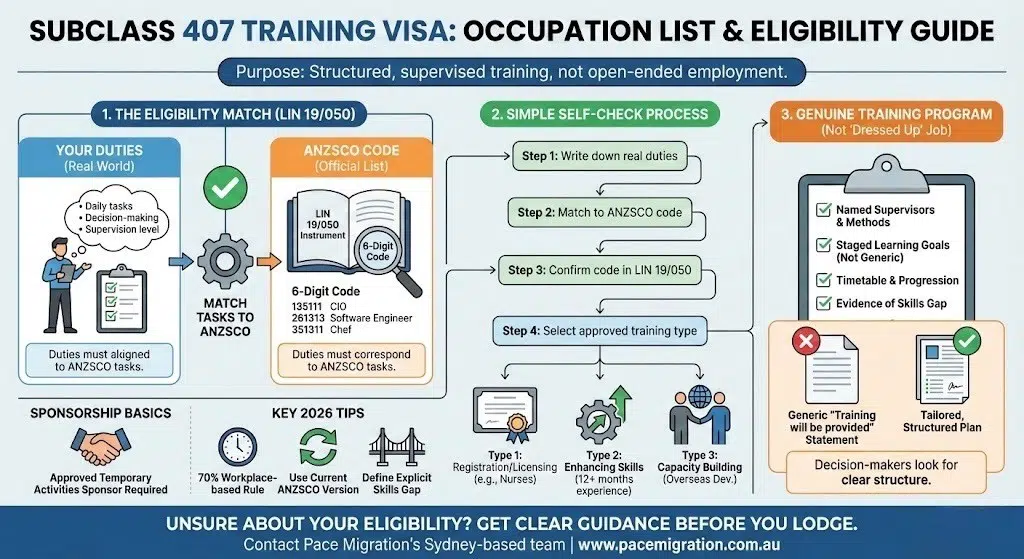
Eligibility usually comes down to two things: your duties must match an occupation listed in Australia’s official Subclass 407 occupation list, and your proposed program must be genuine workplace-based training, not ordinary employment dressed up as “training”.
The occupation list itself sits in a legal instrument (LIN 19/050) and uses six-digit ANZSCO (Australian and New Zealand Standard Classification of Occupations) codes to define occupations.
The occupation list for the Training visa is set out in LIN 19/050, a Federal Register of Legislation instrument. It explains that an occupation applies to a nominee only if the tasks they will perform correspond to the tasks in the relevant ANZSCO occupation.
This point matters because many job titles overlap. The safest approach is to match what you actually do at work to an ANZSCO occupation, then confirm that occupation appears in the instrument.
Home Affairs describes the visa as allowing workplace-based occupational training to improve skills for your job, area of tertiary study, or professional development.
Decision-makers tend to look for clear signs the program is structured, such as:
This is also where 407 visa nomination requirements can catch people out: the paperwork needs to support the training purpose, not just show you are employable.
LIN 19/050 is long. Here’s a short, mixed sample of occupations that appear in the instrument, with their ANZSCO codes. Treat these as examples, not a complete list, and always confirm the current instrument for your own occupation.
Examples from the Medium and Long-term Strategic Skills List (MLTSSL) in LIN 19/050
Examples from the Short-term Skilled Occupation List (STSOL) section
If your occupation isn’t on the sample list above, that doesn’t mean you’re ineligible. It usually means you need to locate your ANZSCO match and confirm it appears in the relevant table of LIN 19/050.
Some cases are straightforward: your occupation is clear, and the training plan is obviously structured. Others are messy, especially when your role blends duties from two or three ANZSCO codes (common in small businesses).
A migration agent in Sydney can help by stress-testing your occupation match against the “tasks correspond” standard in LIN 19/050 and tightening the training plan so it reads like training rather than a normal job.
Most applicants will need an organisation that is an approved Temporary Activities Sponsor. Home Affairs explains that you must be an approved sponsor to sponsor someone for certain activities or streams, including subclass 407.
If your sponsor is not approved yet, sponsorship approval can become the first step, before nomination and the visa application.
If you’re unsure whether your occupation and training plan line up with the 407 rules, speak with Pace Migration’s Sydney-based team and get clear guidance before you lodge.
Also Read: Skills in Demand 482 Made Simple: The New Australian Work Visa Explained
Use the Federal Register of Legislation. The relevant document is LIN 19/050 (Specification of Occupations, Subclass 407). It lists occupations in tables with ANZSCO codes and explains that your occupation applies only if your tasks correspond to the ANZSCO tasks for that code. That “tasks” wording is why job titles alone don’t settle eligibility.
No. Listing is only one part of the story. You still need a genuine workplace-based training program that fits one of the accepted training types described by Home Affairs. If the plan reads like ordinary paid work (with training mentioned in passing), the application can run into trouble.
Home Affairs sets out three occupational training types for this visa, including training required for registration, training to improve skills in an eligible occupation, and training for capacity building in some circumstances. The nomination requirements differ depending on the training type, so it’s worth choosing the right category early and building evidence around it.
In most cases, yes. The visa is designed around sponsorship and nomination. Home Affairs states that an organisation must be an approved Temporary Activities Sponsor to sponsor people for certain visas, including subclass 407. If the business has never sponsored before, allow time for that approval step.
The Training visa is temporary. Home Affairs describes it as allowing you to take part in workplace-based occupational training activities, with the stay period tied to the approved activity (often up to two years). The exact duration depends on what is nominated and granted, so the dates on your visa grant notice matter.

Syed Rahman
Mr. Rahman is a knowledgeable professional with expertise in academia, corporate management, and migration law. He holds a Post Graduate Certificate in Australian Migration Law from ANU, an MBA in International Business from UTS, and a BBA from Baruch College. With 5 years of corporate management experience, 4 years of teaching experience in Australia, and over 15 years as a registered Migration Agent, Mr. Rahman has a strong background in helping international students and skilled migrants with Australian migration law.
Tags: migration agent in sydney, Subclass 407
No Comments »
Book an Appointment or Quick Enquiry
© 2007-2026 PACE Migration & Education Consultancy. All Rights Reserved. | Find Us on Top4