
Recent Posts
January 19, 2026 Pace Migration PR Pathways

Table of Contents
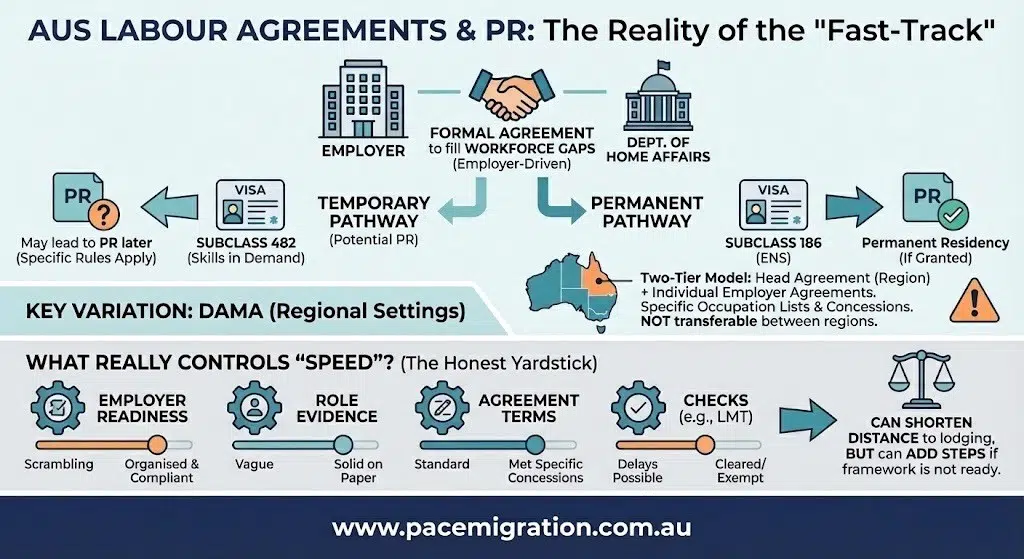
Plenty of people hear “fast-track” and assume there’s a special lane to permanent residency. The truth is, labour agreement for Australia PR pathways can be faster for some applicants, but only when an employer already has the right framework in place and you meet the terms tied to it. A labour agreement is employer-driven, and it exists to fill real workforce gaps under rules set by Department of Home Affairs.
A labour agreement is a formal arrangement that lets an approved employer sponsor overseas workers under conditions written into that agreement. It’s usually used when standard skilled visa settings don’t fit the employer’s ongoing needs.
For applicants, the key point is this: you don’t apply for a labour agreement on your own. You apply for a visa through an employer who is already a party to one, or who has taken the steps to secure one.
Most “fast-track” talk comes from two employer-sponsored pathways:
A labour agreement doesn’t automatically make processing quick. What it can do is set tailored requirements for the role and the worker, which can make eligibility more achievable in specific industries.
Not all labour agreements look the same.
One well-known category is Designated Area Migration Agreements (DAMA).
A DAMA is a two-step hiring program for specific parts of Australia.
First, the government makes a deal with a regional authority to set special migration rules for that area. Second, a local business in that area applies to use those rules to hire an overseas worker.
“Regional settings” means these rules change by location. Each area has its own list of allowed jobs and its own requirements for things like age, salary, or English levels.
If you want an honest yardstick for whether a labour agreement could feel like a fast-track, look at the moving parts that actually create delays:
So yes, a labour agreement can shorten the distance between “I have a sponsor” and “I can lodge a visa”. But it can also add steps when the employer is still negotiating the agreement or can’t show what the Department expects.
Professional advice can help, especially where agreement terms get technical. You may also come across migration agent in Sydney for labour agreement services. If you’re going down that route, make sure the adviser is properly registered.
A solid migration agency in Sydney for PR consultation should leave you with three clear takeaways: the likely visa stream, the eligibility gaps (if any), and a document plan that splits responsibilities between you and the employer.
No. A labour agreement can make a pathway workable where standard settings don’t fit an employer’s genuine workforce gap, but it doesn’t guarantee speed or approval. Processing time and outcomes still depend on correct nomination, strong evidence, and meeting the agreement terms and visa requirements. If someone sells it as a sure thing, treat that as a warning sign rather than a benefit.
The employer does. Labour agreements sit on the sponsoring side of the process. As the applicant, you apply for the visa in the relevant labour agreement stream once the employer can lawfully nominate you under their agreement. This is why job readiness matters: even a well-written agreement doesn’t help without a real role and an employer able to support the nomination and visa steps.
Two common ones are the Employer Nomination Scheme subclass 186 Labour Agreement stream (permanent visa) and the Skills in Demand subclass 482 Labour Agreement stream (temporary visa).
Some people enter on a 482 and later move to a PR pathway if eligible and if the employer continues sponsorship, but the right option depends on the agreement terms and the nominated role.
Start with the official register. The Department of Home Affairs notes you don’t need an agent, but if you choose to use one, you should check they are registered through OMARA before you pay fees or hand over documents. Registration is a basic filter, not a quality guarantee, so also ask direct questions about experience with employer sponsorship and labour agreement evidence.
Ask whether they already hold a labour agreement, which visa stream they plan to use for you (186 permanent or 482 temporary), and what they can provide for nomination evidence. Also ask who pays which costs, what your role and duties will be in writing, and what support looks like if the plan involves moving from temporary sponsorship to PR later. Clear answers early usually signal a sponsor who is organised.
General information only. Visa rules can change and individual circumstances vary. For tailored advice, consider speaking with a registered professional.

Syed Rahman
Mr. Rahman is a knowledgeable professional with expertise in academia, corporate management, and migration law. He holds a Post Graduate Certificate in Australian Migration Law from ANU, an MBA in International Business from UTS, and a BBA from Baruch College. With 5 years of corporate management experience, 4 years of teaching experience in Australia, and over 15 years as a registered Migration Agent, Mr. Rahman has a strong background in helping international students and skilled migrants with Australian migration law.
Tags: labour agreement for Australia PR, migration agency in Sydney, migration agent in sydney
No Comments »
Book an Appointment or Quick Enquiry
© 2007-2026 PACE Migration & Education Consultancy. All Rights Reserved. | Find Us on Top4