
Recent Posts
January 26, 2026 Pace Migration Migration

Table of Contents
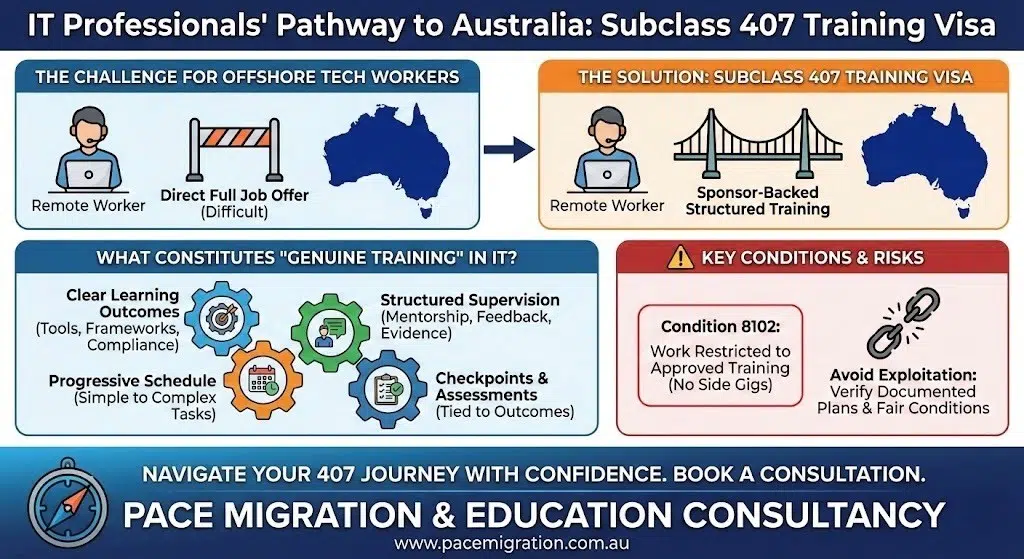
For many technology workers offshore, the hardest part of moving to Australia isn’t proving capability. It’s finding a visa option that fits the reality of hiring from overseas. The 407 training visa in Australia has started to attract attention because it offers a structured, sponsor-backed way to undertake workplace training in Australia when a full job offer isn’t on the table yet.
The Training visa (Subclass 407) is designed for people coming to Australia to participate in workplace-based occupational training or professional development that builds skills for a job, study, or field.
That distinction matters in IT, where “training” can look like day-to-day project work unless it’s clearly planned and supervised.
For employers, it can feel more manageable than full sponsorship for an ongoing role. For applicants, it can be a chance to gain Australian workplace exposure, learn local standards, and build professional networks, all within a defined program.
In tech, training is credible when it reads like a program, not a job description. Strong plans usually include:
If an application can’t explain why the person needs training, or how the sponsor will deliver it, decision-makers may treat it as ordinary employment.
Many applicants assume the 407 allows broad work rights. In reality, visa holders often have condition 8102, which restricts work to activities related to the approved study or training.
That affects side gigs, unrelated casual work, and “just helping a mate” arrangements.
The safest approach is to keep your work tightly connected to the training plan, and to keep records of training, supervision notes, and progress. Those details matter if questions come up later.
In January 2026, reporting on a NSW coronial matter described a case where a young worker who arrived on a subclass 407 was found to have been exploited, with the matter referred for further investigation.
The point isn’t to write off the visa. It’s to push for basic checks. A legitimate program should feel like training: documented outcomes, supervision, and work that matches the plan. If it sounds like long hours, vague “learning on the job”, and pressure to accept poor conditions, step back.
Some applicants can manage forms on their own, then get stuck when the training plan doesn’t match the visa intent. A registered migration agency can help test whether the arrangement reads as genuine training, and whether the evidence supports the claims.
If you do use an agent, Home Affairs says you should check the official register to confirm the adviser is registered.
Any promise of “guaranteed approval” should set off alarm bells.
Book a consultation with Pace Migration & Education Consultancy to check whether your training arrangement is structured, compliant, and supported by the right evidence. You can meet in person or via Zoom through their booking page.
Also Read: 407 Eligibility Checklist: Skills, Experience & English—What You Actually Need
No. The Subclass 407 is built around sponsorship and nomination for an approved training activity. You generally need an Australian organisation that is already approved (or can become approved) and is willing to nominate you for a structured training program.
The visa duration depends on the approved training program, and Home Affairs notes it can be granted for up to two years. Your visa grant letter will confirm the exact dates and conditions for your case.
Be careful. Condition 8102 may apply, which restricts work to activities related to study or training. If a second job isn’t connected to your approved training, it may breach your visa conditions.
Common issues include training plans that read like ordinary employment, weak evidence of supervision, and unclear outcomes. Missing documents can also cause refusal. Decision-makers look for a genuine training need and a structured program that matches the visa’s purpose.
Not directly. The 407 is a temporary training visa. Some people use the time in Australia to build experience and employer relationships, then explore other visas later if they qualify. Treat it as a defined training period, not a promised pathway.

Syed Rahman
Mr. Rahman is a knowledgeable professional with expertise in academia, corporate management, and migration law. He holds a Post Graduate Certificate in Australian Migration Law from ANU, an MBA in International Business from UTS, and a BBA from Baruch College. With 5 years of corporate management experience, 4 years of teaching experience in Australia, and over 15 years as a registered Migration Agent, Mr. Rahman has a strong background in helping international students and skilled migrants with Australian migration law.
Tags: 407 training visa in Australia, Pace Migration & Education Consultancy
No Comments »
Book an Appointment or Quick Enquiry
© 2007-2026 PACE Migration & Education Consultancy. All Rights Reserved. | Find Us on Top4